

STEAM SNIPS Lessons are designed to align with the International Society for Technology in Education ISTE Standards, Next Generation Science Standards NGSS, and the Common Core State Standards CCSS.
STEAM SNIPS™ are electronic building modules that can be combined in an infinite number of ways, creating all sorts of electronic inventions.
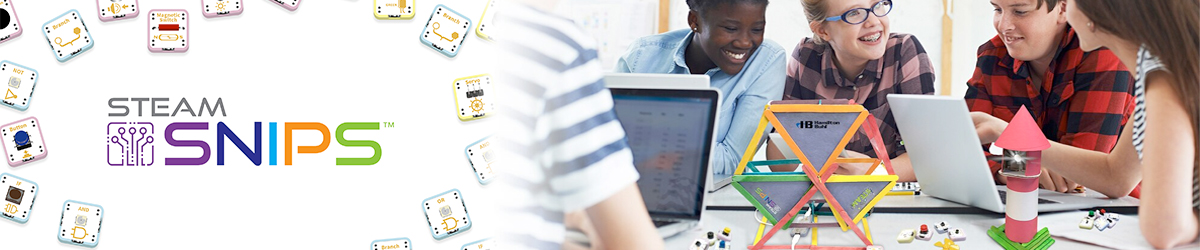
STEAM SNIPS™ include 73 different components, each can work with every other module in the set – all that is needed is imagination, inspiration and curiosity to build an infinite number of combinations of electronics products.
- Power modules – everything requires energy
- Input modules – sensors and detectors to sense, detect and collect environmental data – sound, light, temperature, humidity, motion,tilt, flame, IR distance, water moisture, ultrasonic, switches, buttons, dimmers
- Output modules – produce motion, audio and visual effects that include LED lights, buzzers, speakers, motors, relays, servos and fans
- Controller– controls output based on logic and can be combined with other programmable modules to adjust input and output parameters.

Students learn how programming code works

How sensors send signals to processor
Recieve signal from input and send to output block

Sends out a visible signal
Putting it all together
Lesson 1
Standard Aligned
CCSS
CCSS Math PracticeMake sense of problem and persevere in solving them
CCSS ELA Literacy
Key Ideas and Details
CSS ELA Literacy
Craft and Structure
CSS ELA Literacy
Integration of Knowledge and Ideas
NGSS
4-PS3 Energy4-PS3-3.Ask questions and predict outcomes about the changes in energy that occur when objects collide. [Clarification Statement: Emphasis is on the change in the energy due to the change in speed, not on the forces, as objects interact.] [Assessment Boundary: Assessment does not include quantitative measurements of energy.]
4-PS4. Waves and Their Applications in Technologies for Information Transfer.
4-PS4-3. Generate and compare multiple solutions that use patterns to transfer information.* [Clarification Statement: Examples of solutions could include drums sending coded information through sound waves, using a grid of 1’s and 0’s representing black and white to send information about a picture, and using Morse code to send text.]
3-5-ETS1-2 Engineering Design
3-5-ETS1-2. Generate and compare multiple possible solutions to a problem based on how well each is likely to meet the criteria and constraints of the problem.
ISTE
EMPOWERED LEARNER
1d Students understand the fundamental concepts of technology operations, demonstrate the ability to choose, use and troubleshoot current technologies and are able to transfer their knowledge to explore emerging technologies.
INNOVATIVE DESIGNER
Students use a variety of technologies within a design process to identify and solve problems by creating new, useful or imaginative solutions.
4b. Students select and use digital tools to plan and manage a design process that considers design constraints and calculated risks.
4c. Students develop, test and refine prototypes as part of a cyclical design process.
4d Students exhibit a tolerance for ambiguity, perseverance and the capacity to work with open-ended problems.
CREATIVE COMMUNICATOR
Students communicate clearly and express themselves creatively for a variety of purposes using the platforms, tools, styles, formats and digital media appropriate to their goals.
6a. Students choose the appropriate platforms and tools for meeting the desired objectives of their creation or communication.
6c. Students communicate complex ideas clearly and effectively by creating or using a variety of digital objects such as visualizations, models or simulations.
GLOBAL COLLABORATOR
Students use digital tools to broaden their perspectives and enrich their learning by collaborating with others and working effectively in teams locally and globally.
7c. Students contribute constructively to project teams, assuming various roles and responsibilities to work effectively toward a common goal.

Solving everyday problems

Brainstorm solutions

Identify problems and solutions

Creative expression and planning

Communicate complex ideas

Lesson 3
Standard Aligned
CCSS
CCSS.ELS-LITERACY.RST.6-8.3CSS.ELS-LITERACY.RST.9-10.3
CSS.ELS-LITERACY.RST.11-12.3
NGSS
NGSS MS-ETS1-2Engineering design
NGSS MS-ETS1-4
Engineering design
NGSS HS-PS3-3
Energy
HS-ETS1-2
Engineering design
ISTE
ISTE Empowered Learner1c, 1d
ISTE Knowledge Constructor
3d
ISTE Innovative Designer
4a, 4b, 4c, 4d
ISTE Computational Thinker
5a, 5b, 5c, 5d
ISTE Creative Communicator
6a, 6b, 6c, 6d
ISTE Global Collaborator
7b, 7c

Control blocks and LEDs

Undertanding conditional loops

IF logic

NOT logic

Branch logic

Lesson 2
Standard Aligned
CCSS
CCSS:ELA-LITERACY.RST.6-8.3Key ideas and details
CCSS.ELA-LITERACY.RST.6-8.6
Craft and structure
CSS.ELA-LITERACY.RST.9-10.7
Integration of knowledge and ideas
NGSS
NGSS: MS-ETS1-1Engineering design
NGSS: MS-ETS1-2
Engineering design
NGSS: HS-PS3-3
Energy
NGSS: HS-ETS1-2
Engineering design
ISTE
ISTE Empowered Learner1c, 1d
ISTE Knowledge Constructor
3d
ISTE Innovative Designer
4a, 4b, 4c, 4d
ISTE Computational Thinker
5a, 5b, 5c, 5d
ISTE Creative Communicator
6a, 6b, 6c, 6d
ISTE Global Collaborator
7b, 7c

Creating an original project

Communicate ideas

Working together

Using appropriate tools strategically

Critique reasoning of others

Lesson 4
Standard Aligned
CCSS
CSS.MATH.PRACTICE.MP1Make sense of problem and persevere in solving them
CSS.MATH.PRACTICE.MP2
Reason abstractly and quantitatively
CCSS.MATH.PRACTICE.MP3
Construct viable arguments and critique the reasoning of others
CCSS.MATH.PRACTICE.MP5
Use appropriate tools strategically
NGSS
NGSS MS-ETS1-2Engineering design
MS_ETS1-3
Engineering design
NGSS MS-ETS1-4
Engineering design
NGSS HS-PS3-3
Energy
HS-ETS1-2
Engineering design
ISTE
ISTE Empowered Learner1c, 1d
ISTE Knowledge Constructor
3d
ISTE Innovative Designer
4a, 4b, 4c, 4d
ISTE Computational Thinker
5a, 5b, 5c, 5d
ISTE Creative Communicator
6a, 6b, 6c, 6d
ISTE Global Collaborator
7b, 7c

Brainstorm solutions

Using software for problem solving

Critical thinking

Coding, inputs and outputs

Applying lessons for solutions

Lesson 5
Standard Aligned
NGSS
K-2-ETS1-2Engineering design
3-5-ETS1-1
Engineering design
3-5-ETS1-2
Engineering design
MS-ETS1-1
Engineering design
HS-ETS1-1
Engineering design
HS-ETS1-3
Engineering design
4-PS3-4
Energy
HS-PS3-3
Energy
ISTE
ISTE Empowered Learner1c, 1d
ISTE Knowledge Constructor
3d
ISTE Innovative Designer
4a, 4b, 4c, 4d
ISTE Computational Thinker
5a, 5b, 5c, 5d
ISTE Creative Communicator
6a, 6b, 6c, 6d